
Our Future Needs to Be Safe
How Did Seeking Safety Become the Enemy of Fighting Climate Change?

In my last essay I suggested that there are four major requisites for the future we want: safety, community, wealth, and joy. Today I focus on why safety is the oldest and perhaps most pernicious of those four, easy to manipulate and impossible to ignore.
Safety. Will we and our family survive? Will we have the ability to thrive, or will it be stolen from us or destroyed by disease or disaster? Will our children grow up strong and take care of us in our old age? Closely related is agency: autonomy, voice, freedom of action, and control over one’s life.
We all thought that climate safety was going to be a big driver for action. Storms, heat waves, loss of habitat, loss of whole ecosystems. From the beginning, simple sea level rise was the headline. “All our coastal cities will drown.” While that has not changed, it has not driven action, either.
Why isn’t safety from climate change a stronger driver for motivating response? First, until recently that danger was always far in the future. The early discourse was constantly focused on 2050 or later. That is just too far in the future to get wide attention. Go look at the concerns that the Yale Program on Climate Change Communication keeps turning up in its surveys.[1] They are mostly things that are immediate, not 2050. Yale’s most recent survey found that Americans are very worried about the following:[2]
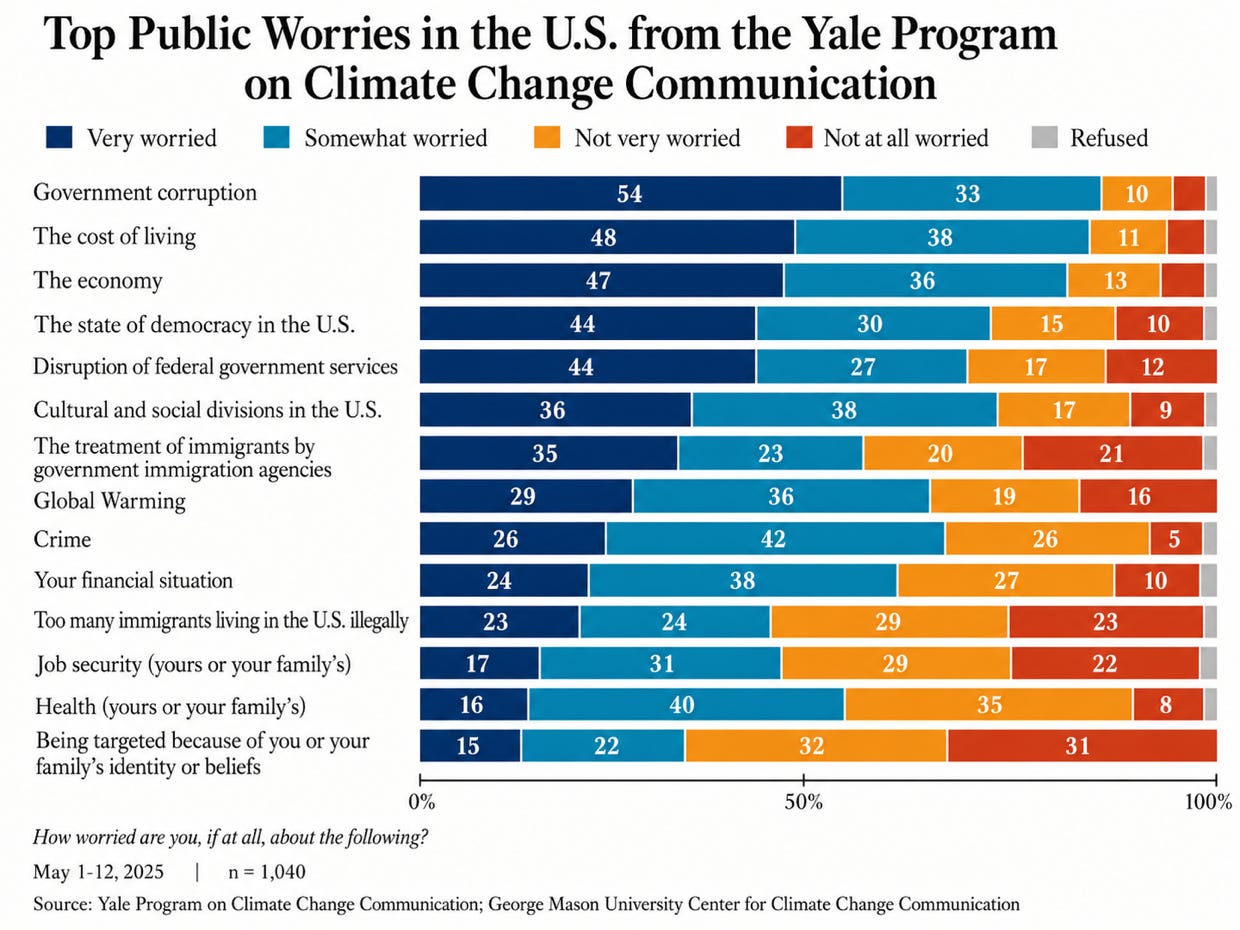
Our need for safety drives us to look at the nearest danger first. We don’t ignore the longer-term ones; it’s just that the most pressing safety issues end up occupying the parts of our brains that are mindful of danger.
The second and probably more insidious problem is that we’re accustomed to dealing with nature as a danger. Humans first moved into caves to get out of the rain, enjoy the warmth of a fire at night, and certainly protect ourselves from roaming predators. Nature. That has not stopped. We spend a lot of money on our artificial protections (buildings) today.
But the extremes of natural disasters: hurricanes, tornadoes, and floods, have always appeared to be random, and therefore not something you can really prepare for. When they happen frequently, like tornadoes in Oklahoma, then they’re not really chance anymore and people prepare for them. We don’t like to anticipate things that are random or occur too infrequently because it’s easier to just hope that it’s not going to happen to us. It is easier to just ignore the risk, like local officials did before the floods along the Guadalupe River in Texas last year. Twenty-five children 8 to 10 years old died at Camp Mystic because of the failures by camp leaders and local authorities to deal with an obvious danger.[3] They had repeatedly failed to install a flood-monitoring system and warning sirens.[4] Ignoring danger does not make it go away.
The fires, floods, and heat waves of the last several years will certainly provide fodder for a more immediate argument from the climate community. The danger is now, not 2050. Those of us who want to fix climate change need to lean into this and stop focusing only on the far future.
The Origins of Human Safety Concerns
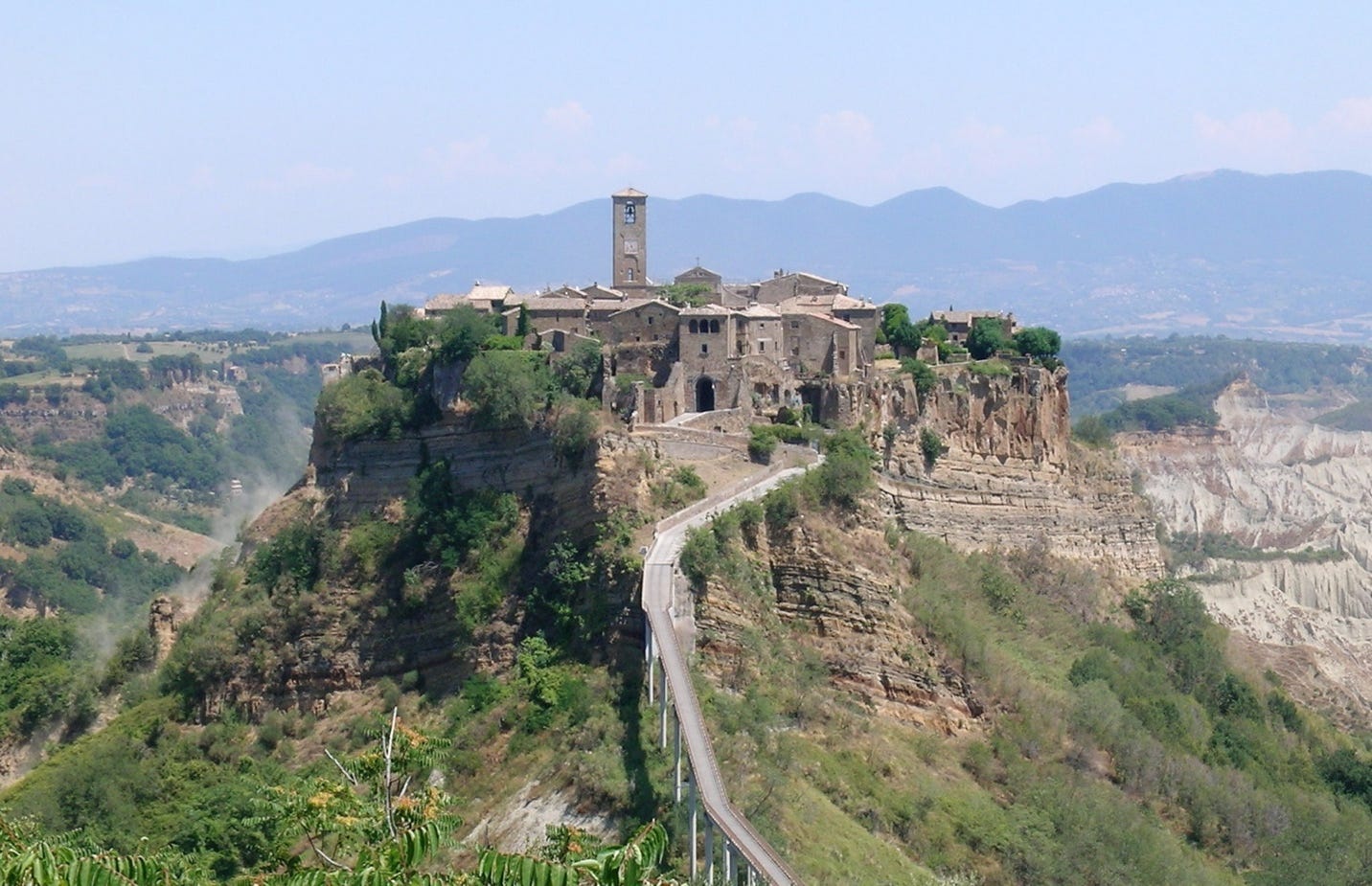
Look around any region where humans have lived for a long time and you will find hill towns. Nowhere in my experience highlights this better than Italy, where impossibly inaccessible towns like the Bagnoregio civita (old section, shown in the photo) show the lengths humans will go to keep themselves safe. First used in the Bronze Age about 1300 BCE, it was a full-on town by 700 BCE.[5] Fortified and refortified over the years, it remained a key Roman town and subsequently passed through Roman, Gothic, and Lombard rule and into papal control. The residents of this town were hauling food, water, and building materials up to the top for thousands of years. What was in their minds? Safety.
The earliest I can trace the human need for safety is back to the caves of our prehuman ancestors. We lived in groups. (I’ll talk about community in my next essay.) We sought protection from nature, wild animals and weather, in those caves. I hope that the transition from protecting ourselves from nature to protecting ourselves from other humans took a long time. There was a lot of space in Africa for humans to spread out and not interact with each other, but I suspect that that may be Pollyannaish of me. (I admit to leaning that way.) There are always better places, easier places to live with better water and better food. Someone seems to always find stealing to be a good path, so safety is deeply, deeply entrenched in human culture and perhaps even in our chromosomes.
Safety is a clear concept when someone is trying to kill you, but that is not generally what it translates to in modern, wealthy societies. Let me trivialize it a bit to reflect modern sensibilities in places like the U.S., where safety is keeping people from taking your stuff. In Bagnoregio the nontrivial expansion of “stuff” was taking your life, taking your wife and children as slaves, taking all your worldly goods, and burning your town to the ground. Think sack of Troy, another Bronze-age hill town whose fate is well known. This is why people fortified a hilltop and carried water up the hill every day when they could have lived by the stream.
The Strongman Pathology
We have not forgotten those fears, even if the stakes are much reduced in most of the world (apologies to Ukraine). If you want to keep your stuff, you have to protect it. That generates a pathology that has not diminished at all with time. A strongman steps up and says, “Those people are coming to take our stuff. We need to close ranks and defend our stuff.” When you live on a hilltop and raiders on horseback have attacked with almost no warning, it’s relatively easy for a strongman to argue that the community needs to protect against that happening again. The fears of the population enable a leader, whom everyone trusts, to organize their defense and to keep their families safe. That leader has an enormous amount of power. Too often, that power is corrupting.
I saw this in Russia when I visited in the early 1990s. Rather than hill towns, Russia’s history is one of strongmen on the steppe and in the forest, with extraordinary power over their population. I could not understand why the Russian people permitted their leaders to have such absolute power. To me it looked abusive. In their museums I learned of the Tatar invasions in 1223, followed by two centuries of foreign domination. I saw the incredible distances between cities in Russia, expanses of unbroken forest. The idea that the wolves were at the door was very real. Whether the wolves were at your door or the Mongol horde at the gates of the city, danger was everywhere. From the 15th through the 18th century the Crimean Tatars (a Muslim conglomerate centered in Crimea but composed of many ethnicities) captured more than 3 million people in Eastern Europe and sold them in Eurasian slave markets. [6] And so rather than being killed or enslaved, people welcomed strongmen and tolerated their abuses in preference to a much worse fate.

The forces we saw creating hill towns in central Italy were reproduced in spirit all across Europe. The need for safety bred a class of leaders who were originally warriors, but came to be people who commanded warriors, then people who paid warriors and had control of the warrior class. They collected taxes to pay those warriors and keep those walls up. They sent out envoys to their neighboring city-states to ostensibly maintain good relations, but of course, a big part of that was simply making allies or preparing to fight an enemy whether in defense or on offense. The cultures of protecting your stuff and taking other people’s stuff became so blurred that people no longer differentiated them, especially when described by a strongman whose position and authority depended upon the existence of that blurred distinction.
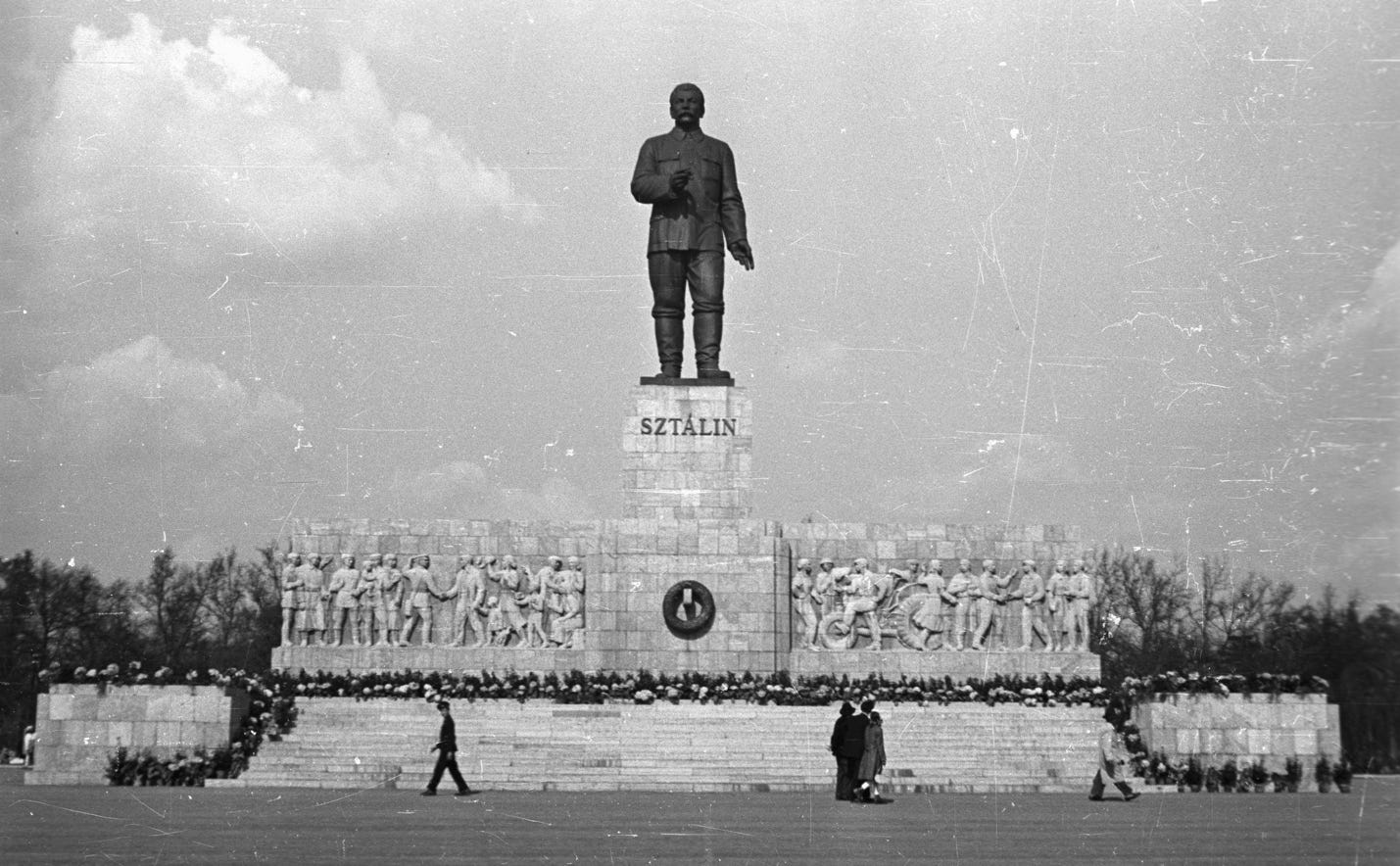
We see that today. After World War II authoritarians claimed power with the message, “Those people are coming to steal your stuff.” Of course those making that claim were actually the ones coming to steal your stuff, not the bogeyman they offered to the public. Authoritarian rulers and regimes, including Stalin, Trump, Putin, Orban in Hungary, and the House of Saud in Saudi Arabia, have exercised their power in a way that maintains their authority and maintains their ability to do what they want. They do not act in the interests of the people they rule. Authoritarian leaders deny that is true. They claim they are protecting against a clear danger–one they have fabricated, promulgated, and turned into a warped reality by repeating it over and over. Their message is that the enemy is always at the gates, ready to take your stuff. But maybe the enemy is within.
How Did Safety Become the Enemy of Fighting Climate Change?
The populist surge in the world today is, of course, a reflection of how easy it is to lie to people about who’s coming to steal their stuff. Now, instead of talking around a campfire to a dozen, lies can be told over the Internet to a million. Most people don’t have time to evaluate those lies. People are used to the idea that they have to be careful themselves and it is simpler to have a strongman in charge, even when he protects us from nothing. They let the lies slide past.
It’s the ease with which a strongman lies that is the problem. We saw this in the kings and dukes of the Middle Ages. We saw it in the rise of authoritarian religions. People are busy with day-to-day concerns. They don’t have the time or the knowledge to evaluate authoritarian claims. Once people have given a strongman the authority to defend their safety, it is very hard to get that power back.
A leader who has centralized authority can downplay the importance of climate change action because it diminishes their central hold over an important part of the economy. Their message to the public is that environmentalists are coming to take their stuff–their fuel, their wealth, and their freedom of choice. Authoritarian leaders have turned fixing climate change into a safety fear. That is especially evident in the petrostates: the Gulf states, Russia and its vassals, Venezuela, and most disappointingly the United States. In these countries, wealth is concentrated in fossil fuels. The sector does not have to represent a large fraction of the economy (like in the U.S. where gas and oil extraction interests directly control about 2–3 percent of the economy[7]); its concentrated ownership still provides substantial leverage. If you control it and encourage it, you have a significant lever on the rest of the economy.
Authoritarians and populist leaders still prey on humans’ biggest fears that someone is going to take your stuff, kill you, and burn your city. They try to replace the fear of climate change with a fear that gives them control. Most of us still fear climate change, but the authoritarian messaging is influential because it creates a more pressing set of fears.
There’s a lot of discussion about the fossil fuel companies being the evil empire that drives climate change. Certainly, their lies fall into the same category as those of the authoritarians, seeking to control the population to their advantage. That is mostly an economic problem, an issue with wealth (who has it and how much is needed). I’ll come back to that and those companies in my third essay in this series, on wealth. But for the issue of having a safe future–one that has the elements in the box at the top of the essay–our challenge is with government. We all want a safe future, and we need government that acknowledges that and acts on it. We want to be safe from real dangers, not told that imagined ones are more pressing.[8]
A Closing Plea for Tolerance in Our Communities
This is a long and important subject. I’m nearing the end of the essay. Let me close by asking everyone to add a little tolerance to their lives.
My grandfather Frank Styer was a Quaker. He was a lifelong member of Rotary and a central pillar of society in the small towns west of Philadelphia, where he owned a nursery and raised his family. He was a conservative man politically who died with a signed picture of Richard Nixon on his dresser (not one of my heroes for certain). But Frank was extraordinarily kind. He was always willing to try to understand why people did what they did. He shared the bounty of his life and his business with everyone, particularly immigrants.
I like to think that I learned some things from him, although I don’t think I can ever be as helpful or as kind as he was. I will try. We can benefit if we say, “Those people aren’t evil because they don’t agree with me. They simply have a different learned set of priorities or they’re being fed a different set of influences and information.” There are people who are part of our community and part of our lives with whom we do not agree, often because they have been unduly influenced by people who simply want power. That arrow points both directions–liberals think it of conservatives, and conservatives think it of liberals. We have to move past that point, as a community, to create the future we want.
In our communities we should work to come to a shared understanding of what we need to do about the future. For my part, I focus on what we need to do about climate. As we saw in the Yale survey data, the great majority of people in the U.S. are concerned about it and want to make changes. Don’t let the authoritarians drive wedges between us. It fuels their dominance. A safe future means one where we avoid as much climate change as possible and repair the resultant damage as best we can. Make the argument about a safe future for our families and our communities, and we can come together to create that future.
Thank you for joining me and stay safe.
[1] Leiserowitz, Anthony, John Kotcher, Marija Verner, et al. 2026. Global Warming’s Six Americas, Fall 2025. New Haven, CT: Yale Program on Climate Change Communication, Yale University and George Mason University. https://climatecommunication.yale.edu/publications/global-warmings-six-americas-fall-2025/; Ayers, Megan, Jennifer R. Marlon, Matthew T. Ballew, et al. 2024. “Changes in Global Warming’s Six Americas: An Analysis of Repeat Respondents.” Climatic Change 177: 96. https://doi.org/10.1007/s10584-024-03754-x. https://climatecommunication.yale.edu/publications/six-americas-changes/
[2] Top Public Worries in the U.S. (2025) Marija Verner, Jennifer Carman, Seth Rosenthal, Emily Goddard, Matthew Goldberg, Eric Scheuch, Edward Maibach, John Kotcher and Anthony Leiserowitz, Yale Program on Climate Change. https://climatecommunication.yale.edu/publications/top-public-worries-in-the-u-s/
[3] Jonathan Allen, “Texas’s Camp Mystic had no evacuation plans on the night of deadly floods, report finds”. Reuters June 19, 2026. https://www.reuters.com/world/us/texass-camp-mystic-had-no-evacuation-plans-night-deadly-floods-report-finds-2026-06-19/
[4] Foley, Ryan J., Christopher L. Keller, Sean Murphy, and Jim Mustian. “A Decade of Missed Opportunities: Texas Couldn’t Find $1M for Flood Warning System Near Camps.” Associated Press, July 9, 2025. https://apnews.com/article/texas-floods-camp-warning-system-not-funded-0845df62390b9623331ba4a030c5fc7d
[5] di Gennaro, Francesco and Barbara Barbaro. “Tabella Riassuntiva Degli Insediamenti Dell’Età Del Bronzo in Etruria Meridionale, in: Preistoria e Protostoria in Etruria VIII, Milano-Macerata 2008, Vol. I, Pp. 129-149,” n.d.
[6] Volha Charnysh and Ranjit Lall, “Consequences of the Black Sea Slave Trade: Long-Run Development in Eastern Europe,” American Political Science Review 120, no. 3 (August 2026): 1127–49, doi:10.1017/S0003055426101439; Hannah Barker, “The trade in slaves in the Black Sea, Russian, and Eastern Europe”. Chapter 5, Cambridge World History of Slavery September 9, 2021. https://www.cambridge.org/core/books/abs/cambridge-world-history-of-slavery/trade-in-slaves-in-the-black-sea-russia-and-eastern-europe/3864C15075B035E3EC090A1D4D357BF2
[7] Federal Reserve Bank of St. Louis, Real Gross Domestic Product: Oil and Gas Extraction (211) in the United States (USOILGASRGSP). Sep 26, 2025 https://fred.stlouisfed.org/series/USOILGASRGSP
[8] Accusing their opponents of doing exactly the thing the authoritarians are in fact doing is central to their playbook. The ultimate lie is to blame the opposition for your own actions.
This is excellent writing, really enjoying this series, and already looking forward to the next one!
Roger, this is a very interesting piece — I'm in full agreement. I've said in many of my talks that mass action on climate change may unfortunately require a massive climate-linked event affecting hundreds of millions of people before we see a more concerted global effort pushing aside geopolitics. We're behaving like the frog in the slow-to-boil pot: too focused on what's right in front of our faces every day (the exoteric) to reckon with the real, esoteric long-term threat to billions or potentially our very existence.