
The Future We Want
The Desire for Safety, Community, Wealth, and Joy Drive Human Endeavor

Eighteen months ago I left my Department of Energy assignment,[1] plagued by the question, “Why aren’t we doing better?” Good people and good technologies are here, and under the Biden administration a lot of money was available. My approach to a problem like this is to try and understand the underlying mechanics. How do things really work? How do people think about them? And after twenty years in energy and climate technology, I decided it is time to reflect on what works and what doesn’t.
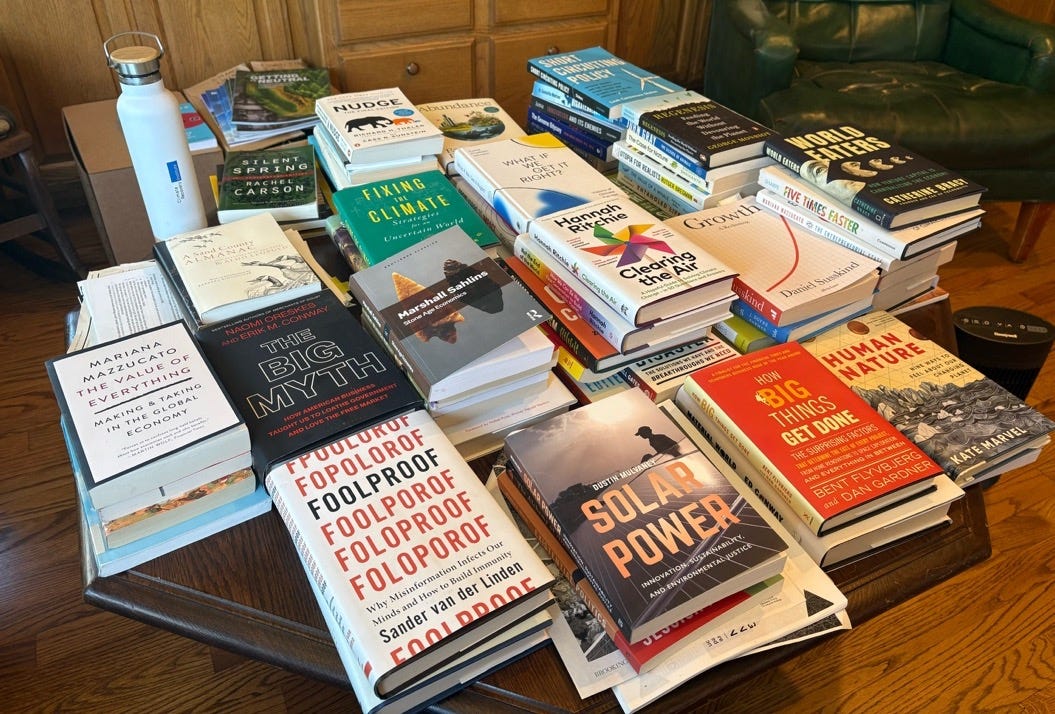
I’ve read more than sixty books and countless posts since then, trying to extract myself from the paralyzing quagmire of all the problems and potential solutions. That reading was enlightening, and some of the material is brilliant. The sheer diversity of good and useful opinions is overwhelming. They are rarely aligned with each other. The diversity helped me realize that the first question about climate change is not “How do we fix all of the contributing problems?” but rather “What is the future we want?”
The social, economic, and climate problems we face are all part of the same future. Looking at climate change from this vantage point helps me see that many of the other pressures on society limit our ability to heal our future. Most importantly, it provides a framework for positive action. What must we do to achieve the future we want?
The first thing I realized, particularly thanks to a lot of thoughtful economics books, is that I must always keep in context all the things besides climate that people think are important. To do this, I try to think about the actions and outcomes we need, rather than the barriers and problems we have. Those barriers, particularly greed and stupidity, get the most attention, but the best information about what people want in their future tends to be reflected in their concerns.
The range of concerns people worry about today and have struggled with throughout history is a basis for understanding what frames our goals. If I can understand those goals, I can apply my detailed knowledge of climate issues without ignoring major things that also must happen to get the future we want. I can avoid taking a Pollyannaish view (all positive and not realistic) of the future, which is unfortunately prevalent for those of us who work on technology.
It is easy to start listing concerns people have about the world, including climate change, and end up with an impossibly long list. Which ones have lasted throughout time and therefore are likely to extend into the future? The pressing problem is that there are pressing problems everywhere, and reasonable public surveys place climate change as low as tenth in the panoply of concerns.[2], [3]
The paralyzing quagmire of problems easily overwhelms us. If we imagine that the overall issue of climate change has one hundred subsidiary issues embedded in it and the same is true for all of the other ten major concerns on our list of imperatives like war, economic failure, and health, the list of potential hurdles for society quickly expands to one thousand items.[4] This sounds like a Chinese proverb. I call it the curse of entropy. Too many problems to solve, too many to even see. We have to avoid the curse.
And so, I have tried to generalize, to extract the essence of these concerns. What desires for the future do those concerns arise from? What are we all trying to achieve? What are the basic requisites of a good future, instead of all the problems we have to solve?[5]
Safety. Will we and our family survive? Will we have the ability to thrive, or will it be stolen from us or destroyed by disease or disaster? Will our children grow up strong and take care of us in our old age? Closely related is agency: autonomy, voice, freedom of action, and control over one’s life.
Community. Will our communities become the good places we imagine? Humans are extraordinarily social animals. We rarely live alone. We take care of others, and they take care of us. Perhaps more importantly, sharing some obligations of life makes it easier to be safe and happy. Throughout time people have recognized that community enables sharing, and sharing can improve everyone’s lives. Whether large or small, we want our communities to thrive.
Wealth. Will we have the resources to accomplish our goals? In our modern world this has become the primary driver for many of us and a pathological driver for too many. It deserves attention because the ways to achieve wealth and the amount we actually need have so many variations and so many immediate impacts on our future climate. An outcome of my arguments in these essays, however, is that wealth is part of a good future but not the ultimate determinant of one.
Joy. What are the things that delight us, that make the struggle of life worth it? What are the small moments that we cherish, and the continuing pleasures that let us thrive even when times are hard? Many would subsume this in meaning: purpose, dignity, virtue, spirituality, and the conviction that one’s life matters. But I prefer to think about joy, in part because it helps me understand why nature is important.
The Harmony of a Good Future
It is easy to assume that my list of requisites is a hierarchy, and there is certainly a sense of time associated with it. At least the first three have historically come in order. (I hope everyone has some joy even if the others are in short supply.) But all four of these must be present for a good life. I think they are very solid foundational elements for the future we want, but not to the same degree for everyone. I certainly hope that community and joy can increase endlessly, while safety and wealth will have diminishing returns at some point.[6] I believe you can be rich and safe enough.
We need all four of these requisites simultaneously, but neither individuals nor societies have to achieve them all to the same degree. I step away from Maslow in this framing by suggesting that what is happening here is not a sequential set of needs but a forward-looking and simultaneous conflict among goals. Since we all view them differently, our Chinese proverb of the 1,000 problems comes into play, and we all choose different paths to achieving the future we want. We each put our resources, time, and attention on different problems. The trick is arriving at the future we want via our different pathways.
If the goal for our future is kumbaya around the campfire, with everyone singing the same song and fully supportive of everyone else (because we are aiming for the same thing), we will fail. We need to accept that there are many good futures and that they all have mixtures of these requisites, but they are not identical.
I think of the balance among the four requisites of the future we want as the harmony of life. Four parts make up the whole but are by no means equal. They change gradually. Sometimes outside forces cause them to change suddenly, but they will always be present in a harmonious future. We will each decide how much of each works best for us. Any realistic plan for creating a future we want has to be tolerant of this ambiguity.
A Framework for System Planning
The utility of thinking about the future in terms of these four requisites is that it enables us to visualize a choir instead of a quagmire. We will move more quickly if we acknowledge that a good future springs from those four, and people and society will travel many paths simultaneously to get there. We cannot spend too much time arguing about whether our path for solving our favorite detailed issue is the right one. The important question is whether it takes into account all four requisites.
At the same time, each detailed path to the future needs to be designed and strengthened and supported and evaluated and implemented – all the things that actually build our future. Each path to the future can be compared and evaluated against other paths by understanding the extent to which the four requisites will be delivered by taking that path. You can easily recognize approaches that are so focused on one of the four that they are damaging to the others. An unfortunate number of climate proposals fall into this category. Their proponents take offense that they got a lot of pushback from people who don’t think the proposal considers the future that they want to have.
This is the primary problem we have in making plans for the future we want. We have to come to grips with everyone’s different views of the future we want and learn to harmonize them. Dealing with greed, stupidity, and sheer meanness has a lot of merit, but focusing solely on that does not build the future we want. We have to consider the positives while we try to get barriers out of the way. We must embrace, rather than dismiss, the desires of people who have a different mix of wants for the future than ours.
I firmly believe that if we acknowledge the goals and desires of others, most of them will return the favor. This is the essence of good community. Is it Pollyannaish to expect our nation and our world to move in this direction? No, it is pragmatic. Our task is not easy and we cannot pretend that it is.
In the essays that follow, I will look at what I have learned about each of the four requisites. How has each evolved? What happens behind the scenes (particularly for wealth)? How does each requisite fit into the story of solving global warming? To a very real extent, this is the travelogue of my journey through climate space – what I learned along the way and what I would like to see more often. I write these to clarify my own thoughts, but I would be honored if you join me on this journey.
Roger
[1] I served as the Senior Advisor for Carbon Dioxide Removal to the DOE Under Secretary for Energy and Innovation (Geraldine “Geri” Richmond) June 2023–January 2025.
[2] For example, Global Warming’s Six Americas 2009: An Audience Segmentation Analysis. Anthony Leiserowitz, Edward Maibach, and Connie Roser-Renouf, Yale Program on Climate Change Communication. Table 7, page 89. https://climatecommunication.yale.edu/wp-content/uploads/2016/02/2009_05_Global-Warmings-Six-Americas.pdf
[3] Marija Verner, Jennifer Carman, Seth Rosenthal, Emily Goddard, Matthew Goldberg, Eric Scheuch, Edward Maibach, John Kotcher and Anthony Leiserowitz (2025) Top Public Worries in the U.S. Yale Program on Climate Change Communication. https://climatecommunication.yale.edu/publications/top-public-worries-in-the-u-s/
[4] OK, those numbers are rhetorical devices, not actual estimates. Give me some slack here to honor the story.
[5] Those of you who know me realize that having four elements, instead of three, tells you how important I think these all are. Three is always the right number unless it is not.
[6] The pathology of the ultra-rich is probably not about wealth, but about a desire for success that becomes their joy. That’s a problem for another essayist.